
.png)
HyperBoost, Spectrum, and SubZero Hop Kief: What Liquid Hops Actually Do to Beer

You’ve probably seen the names printed on modern #IPA cans: HyperBoost, Spectrum, Incognito, DynaBoost, SubZero Hop Kief.
They sound less like brewing ingredients and more like a new superhero association.
A few years ago, a brewery may have proudly said its IPA was double dry-hopped with Citra and Mosaic. Now the same label reads:
Citra T90, Citra Cryo, Citra HyperBoost.
At some point, you have to wonder whether the brewer made an IPA or selected every available upgrade from the hop dealership.
There is a reason these products keep appearing. Breweries want stronger #hop aroma, but traditional dry hopping has limits. Pellets absorb beer, create piles of green sludge, and can add grassy or harsh flavors when pushed too far.
Adding twice as many hops also doesn’t necessarily create twice as much aroma.
Liquid hop products concentrate the parts of the hop that brewers want without putting as much plant material into the tank. They can improve aroma, reduce beer losses and give brewers another way to shape the final flavor.
They aren’t a magic button marked MAKE IPA BETTER, though.
From T90 to liquid hops

Most breweries use T90 pellets. These are dried hop cones that have been ground and compressed into small green pellets.
They contain lupulin, the yellow powder inside the hop cone that holds many of the oils, resins, and acids brewers want. They also contain leaves and other plant material that absorb beer and eventually become waste.
Cryo Hops remove much of that green material and keep a higher proportion of lupulin. Brewers often combine T90 and Cryo because T90 gives a broader hop character, while Cryo adds concentrated oils and resins with less plant matter.
Liquid hop products take this further.
Instead of dropping several kilograms of pellets into a tank, a brewer might add a small amount of thick extract. It usually looks somewhere between honey, engine oil and something you would be concerned to find leaking from your fridge.
Hop extract itself isn’t new. Large breweries have used extracts for efficient and consistent bitterness for decades. What is newer is the focus on aroma and flavor.
Many modern extracts are variety-specific. Mosaic extract should still taste like Mosaic, while Simcoe extract should still give the pine, citrus and fruit people expect from Simcoe.
Incognito, HyperBoost, Spectrum and Hop Kief compared
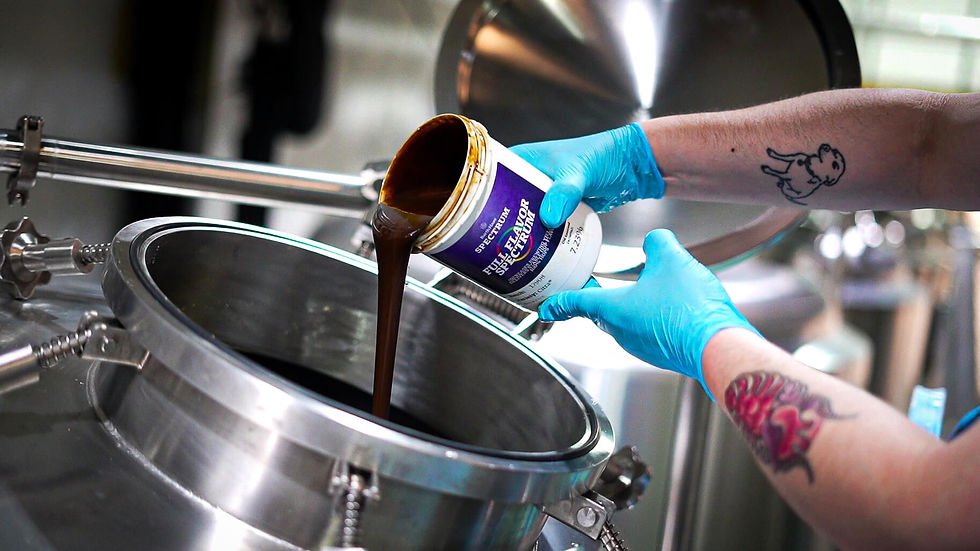
The names are confusing because these products aren’t all used at the same stage.
Incognito (BarthHaas Group) and DynaBoost (Yakima Chief Hops) are mainly designed for the whirlpool, after boiling but before fermentation. They build hop flavor without leaving large amounts of pellet material behind. They also contain alpha acids, so they can contribute some bitterness.
HyperBoost (Yakima Chief Hops) is a highly concentrated hop oil product usually added during or after fermentation. It is especially good at turning up selected aromas such as tropical fruit, citrus, pine, or resin. Around 8 to 10 grams can replace the aromatic contribution of roughly one kilogram of T90 pellets, depending on the beer. It is normally used alongside T90 or Cryo rather than replacing the entire dry hop.
Spectrum (Barth Haas) is designed as something closer to a complete liquid dry hop. It contains hop oils, bitter compounds, polyphenols, and other hop components, but disperses through the beer without leaving a layer of pellet sludge. A 2023 BrewingScience study found that a pale ale made with soluble hop extracts had broadly similar sensory results to one dry-hopped with pellets, while producing around 10 percent more packaged beer.
SubZero Hop Kief, made by Freestyle Hops in New Zealand, is a lot-specific aroma product. A Nelson Sauvin version should reflect the character of the actual hop lot it came from. It can be added very late, including shortly before packaging, and contains no alpha acids, so it is intended for aroma rather than bitterness.
That late addition gives brewers a way to adjust a finished beer. If the Motueka character feels weaker than expected, they can add a carefully measured amount instead of reopening the tank and throwing in another bag of pellets.
The words carefully measured are important. With products this concentrated, a small mistake can change an entire batch. There are plenty of other liquid hop products on the market, but for this article we’ve focused on some of the most widely used and talked-about options right now. If there’s another one you think deserves a mention, drop it in the comments.
Why breweries use them

The biggest advantage is yield.
Hop pellets behave like small green sponges. They absorb beer, settle at the bottom of the tank, and leave behind a mixture that the brewery usually can’t sell.
Losing 20 liters doesn’t sound dramatic until it happens in every batch. In a brewery making heavily dry-hopped beer every week, those losses quickly become expensive.
Liquid products create less solid waste, require less cold storage space, and are easier to handle. Carrying one bottle up a brewery ladder is also considerably less annoying than carrying several boxes of pellets.
They may also help reduce hop creep.
Hop creep happens when enzymes from dry hops break down sugars that the yeast can ferment. Fermentation can restart, potentially creating extra alcohol, diacetyl, or unwanted pressure after packaging.
Products with little or no solid hop material may introduce fewer of those enzymes. That doesn’t remove every risk, but it gives brewers another way to control the process.
There is also a limit to what massive dry hopping can achieve. At very high rates, adding more pellets can create extra grassy flavor, harshness, and astringency without delivering the same increase in fruity aroma.
Sometimes the answer to “How can we make this hoppier?” is something smarter than adding another 20 kilograms.
What can go wrong?
Concentrated hop products can taste concentrated.
Used carefully, they can make a hop profile brighter and fill gaps. Used badly, they can make beer smell oily, perfumed or strangely disconnected from the flavor underneath.
You may get an enormous passion-fruit aroma followed by a sip that tastes like ordinary pale ale.
Your nose was promised a tropical holiday. Your mouth received a Tuesday afternoon in Zurich, on January 1st.
Extracts can also emphasize one part of a hop without reproducing everything found in the original pellet. Loud and complete aren’t always the same thing.
There is no universal conversion rate either. Yeast, alcohol, temperature, mixing, and contact time all affect the result.
A supplier’s dosage gives the brewer a sensible starting point. It doesn’t guarantee an identical beer.
Are liquid hops replacing pellets?

Probably not.
Some breweries can replace a large part of their hop additions with liquid products, but many modern hop bills combine several formats.
T90 gives the broad character of the hop.
Cryo provides concentrated lupulin with less green matter.
Incognito or DynaBoost can build flavor in the whirlpool.
HyperBoost can increase selected aromas.
Spectrum or SubZero can add cold-side intensity without filling the tank with another layer of sludge.
Think of tomatoes.
Fresh tomatoes, tomato paste, and sun-dried tomatoes are all tomatoes, but they contribute different flavors and textures. Using one doesn’t automatically make the others unnecessary.
Please don’t call HyperBoost the tomato paste of beer after a brewer’s fourth IPA. They may spend the next hour explaining why the comparison is chemically inaccurate.
Does extract mean artificial?
Usually, no.
These products are made from hops. They separate or concentrate compounds already present in the plant. Some use a carrier or a small amount of alcohol to make them easier to handle and mix into beer.
That isn’t fundamentally stranger than grinding hop cones into pellets or separating lupulin to make Cryo.
The word extract still makes some drinkers imagine artificial mango syrup being squeezed into the fermenter. That does happen in some flavored beers, but it is a different process.
A badly designed IPA also doesn’t become good because someone added HyperBoost.
It may simply become a badly designed IPA that can now be smelled from across the room.
What should you expect when you see these names on a can?
Usually, you can expect intensity, especially when a brewery combines liquid products with T90 or Cryo. You may notice brighter fruit aroma, less grassy character, and a hop profile that stays present throughout the glass.
You might also notice nothing unusual.
The brewery may have used an extract mainly to reduce beer loss while keeping the flavor close to an existing recipe.
The strange names on the can don’t define quality. They simply tell you which tools the brewer used. Liquid hops give breweries more control over aroma, waste, and yield. Pellets aren’t disappearing.
They simply have some very concentrated new colleagues.
Cheers,
Your Swiss Beer Tour Guides


Comments